Source:. www. drive. ru.
 |
Logo of Mercedes - Benz. |
History of the German company. Daimler-Motoren-Gesellschaft (« Daimler Motor- Gesellschaft ... In addition to the machines, it produced marine and aircraft engines, which gave rise in 1909 to a three-beam star logo - a symbol of success marks on land, water and air. In 1926, the merged firms Daimler and Benz (« Benz ... As such, the logo is often used today, along with the logo pictured here.
 |
Gottlieb Daimler. |
In 1901 the name. Mercedes. has become a trademark of cars.
-produced by German company Daimler-Motoren-Gesellschaft. She founded the Gottlieb Daimler (Gottlieb Daimler) in 1890 in Bad Kannstadt near Stuttgart, on the basis of his studio, where he built the years 1885-1886 is considered the world's first four -wheeled car with a gasoline engine.
 |
Wilhelm Maybach. |
In 1899, Wilhelm Maybach (Wilhelm Maybach), took an active part in the creation of the first cars Daimler built a car Rhoenix -Daimler (« Phoenix- Daimler ... with. , With a number of serious technical deficiencies. At the time, had a significant impact Emil Jellinek (Emile Jellinek), head of Daimler in France and the Consul of the Austro- Hungarian Empire in Nice. He managed to convince a new Maybach car, which was ready in 1901. At the suggestion of Jellinek, the car was named after his daughter Mercedes.
 |
Emil Jellinek and his daughter Mercedes. |
First Mercedes- 35R5 with a 4- cylinder engine cylinder capacity of 5913 cubic. cm had a classical arrangement of units (front engine, rear -wheel drive ) and had the appearance, which also became known as the classical. It became the basis for the development of all subsequent models produced since 1902 under the brand name Mercedes-Simplex (« Mercedes- Simplex ... The most famous representatives of this series includes models with 40/45PS and 60PS engines in 6785 and 9235 cubic. cm, the latter of which developed a speed of 90 km / h.
In subsequent years, Daimler produced a whole range of cars, ... cm, including a luxurious model with a fully enclosed bodywork Some of them were equipped with engines valveless Knight (« Knight ... cm remained in production until 1924. Race ...
 | ||
One of the first post-war models - Mercedes 28/95PS. |
Among the first post-war car was the model 28/95PS with 6- cylinder engine in a 7250 cm3, where Paul Daimler in 1921-1922 experimented with interior blower ( compressor), driven by the crankshaft and increases engine power by about a factor of 1.5.
 |
The representative of the very popular. 20-s. years a series of Mercedes 24/100/140 PS. |
This work continued in 1923, the new chief engineer Ferdinand Porsche (Ferdinand Porsche). That same year saw the first cars with 4-cylinder engine capacity of 1568 cc and 2614. cm, equipped with superchargers, and since 1924 has produced a famous series of 24/100/140 PS with a six -cylinder engine of 6,240 cm3 capacity 100-140 liters. with.
 |
Compressor. Mercedes-Benz. 24/110/160 PS. K nicknamed ... engine and a high top speed. |
After the merger in 1926, Daimler and Benz companies a new group Daimler-Benz was able to leverage the expertise of designers from both companies, which stood at the head of Ferdinand Porsche (Ferdinand Porsche). It is fully updated product range, based on recent models of Daimler, now being issued under the name Mercedes-Benz. The first new design in 1926, Porsche became the ... cm. For more power and speed ( up to 145 km / h) it was called ...
 |
Mercedes-Benz. Mannheim- 370. is based on. past the end of the Porsche models. 20-s. |
In 1928, Porsche left Daimler-Benz, and was succeeded by Hans Niebel (Hans Nibel). Under his leadership, released cars Mannheim- 370 ( ...
In 1930 appeared Grosser Merceries (« Grand Mercedes... cm, with independent suspension front wheels.
 |
Big, beautiful and prestigious. Mercedes-Benz. 770 had the eight-cylinder engine capacity of 200 liters. c. |
 |
five-liter. Mercedes-Benz. 540 K was equipped with a compressor. and enjoyed a good success. |
In 1933 there were passenger Mercedes- 200 Mercedes- 380 sports a 2.0 - and 3.8 -liter engines, the latter of which developed 140 hp. with. supercharged. On the basis of the sports model in 1934 created the Mercedes-500K with a 5- liter engine, which became a 2-year basis for a more well-known large ... In 1934-1936 years the company has released a lightweight Mercedes- 130 with 4-cylinder 26- horsepower rear-mounted cylinder capacity of 1308 cubic. cm, followed by 150 roadster and sedan 170H.
 |
The world's first car with a diesel engine was named. Mercedes-Benz. 260 D. |
 |
First come off the assembly line after the war became a model. 38 -strong. Mercedes-Benz. 170 U. |
During the war, Daimler-Benz produced as trucks and cars of different classes. In the post-war reconstruction of destroyed factories took time, so the car production was started only in 1946. The first was the pre-war Mercedes-Benz 170U with 38 -horsepower engine. After three years in sale of its diesel variant.
Among the first new development was the popular Mercedes- 180 (1953 year) with a monocoque body pontoon type, as well as a solid series of 220 and 300. Class sport models in 1951 led the 300S with a 6- cylinder engine in a 2996 cubic. cm, overhead camshaft.
 |
Mercedes-Benz. 180 enjoyed good demand, and was one of the. first post-war development of the company. |
In 1954 came the famous 300SL sports car with the doors of the ... The following year, was released on an inexpensive compact convertible 190SL with a 4- cylinder engine in 1897 cc. cm.
 |
The famous coupe ... |
In 1958, there was a technical revolution - went into production engines with high-precision mechanical fuel injection system of firm Robert Bosch (« Robert Bosch ... This allowed the model to increase power 220SE 2.2- liter 6- cylinder engine from 106 to 115 l. with. (followed by up to 120 l. with. ). From that time until 1994 in the designation of many models of Mercedes-Benz was the letter E, that is, the fuel injection.
 |
Mercedes-Benz 220 SE - one of the first models with fuel injection system. |
In 1959, a new family of middle-class cars (factory index W- 111), received elegant bearing body with vertical blocks of lights, huge luggage compartment and all-wheel independent suspension (models 220, 220S and 220SE). They have demonstrated the highest technical level of vehicles of this brand.
 |
Mercedes-Benz. 220 S (W111) embodies all the latest in the automotive industry, demonstrating a high technological level of Mercedes. |
At the end of 1963 was the Model 600 is shown a representative class. It was equipped with a 6.3- liter V8 engine producing 250 hp. with. , Automatic 4- speed transmission, suspension, wheels for a comfortable pnevmoelementah. This car has a top speed to 204 km / h.
 |
Executive Mercedes S600 equipped with 6.3- liter engine to 250 horsepower. |
Mercedes-Benz 600, claiming to be the best car of the world, manufactured in the embodiment Pullman (« Pullman ... Sport model in 1963 replaced the more modest Mercedes-Benz 230SL ( factory index W- 113) with the original roof ( it made the middle part just below the side walls ). Successors 230SL - 290SL/350SL cars with factory index W- 107 - appeared at the end of 1971 and remained in the program until 1989, when he was replaced by a modern series of SL (W- 129).
 |
Mercedes-Benz. 230 SL (W- 113) was more modest and. affordable sports cars that preceded it. |
At the Frankfurt Motor Show in 1965 was the first time shows range of models of so-called S-Class (W- 108) - the most prestigious (after the flagship 600) car company in those years. It includes a model 250S and 250SE with a 6- cylinder engines in the 150 and 170 l. with. By its technical parameters exceeding competitors. Over time, they were in the 2.8-liter engines, and from 1968 - 3.5 - and 4.5 -liter V8 engines. The most powerful and comfortable model in the series was extended from 6.3 300SEL 6,3 -liter V8 engine producing 250 hp. with. , A maximum speed of 220 km / h From this point on S Series has become a symbol of technological developments of Mercedes-Benz.
 |
Mercedes-Benz. 300 SEL (W- 108) after the S600 is the most powerful and prestigious representative of the series S, embodies the technical achievements of the company. |
In 1972, a new generation S-Class (W- 116), replaced in 1979, W- 126 machine with an aerodynamically perfect bodies ( the model of the 280S to the 560SEL).
 |
New Generation Series S -. Mercedes-Benz. S-class. (W116) - stayed on the line for seven years, after which he was replaced by aerodynamically perfect model. S-class. (W- 126). |
Most mass production of the company - a middle class car (W-110/111) - in 1967, was replaced by a large series of models ( from 200 to 280E, W-114/115). This family produced not only from the bodies of 4- door sedan, and five -door wagon and 2- door coupe and hardtop (with window openings without intermediate columns).
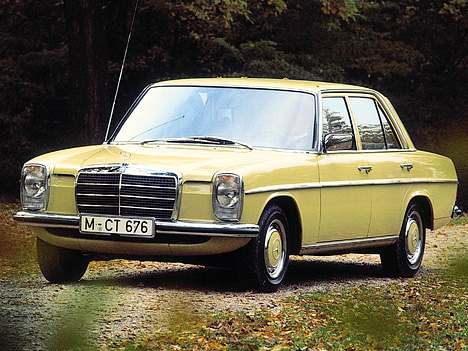 |
Mercedes-Benz. 200 E (W- 115) were represented by one of the most popular segments - cars of the middle class. |
Received widespread popularity of these models of complete diesel. Further development of the steel series W- 123 (1976 year) and W- 124 (1984-1995 gg. ) The last 11 years of its release proved to be very popular. It was produced over 2.7 million. Car ( model 200 to 500E ).
 |
Over 11 years of production. Mercedes-Benz. E-class. (W- 123) car sold on the world in the amount of 2.7 million pieces. |
Cars compact size, from which the firm refused in the 50s, re-emerged only in 1982 (W- 201). The series consisted of 190 models in several trim levels with the engine cylinder capacity of 1.8-2.6 with a capacity of 75-185 liters. with.
 |
Mercedes-Benz. C-class. (W- 201) - the first compact car Mercedes, since. 50th. years. |
In the 90s there was a radical restructuring program Mercedes-Benz. The company introduced its products to several new market sectors. However, the basis of the program are still cars classic layout Series C and E. In 1998, the range of Mercedes-Benz models is extensive. Customers are offered dozens of models and modifications of the 12 individual series ( families).
 |
Mercedes-Benz. E-class. (W- 124) - a great car in all respects. Even after a long time a good instance of this series is worth a king's ransom. |
Miniature Model A -Class (W- 168) manufactured since 1997 and serve in one of the most popular among Europeans class of machines. These models feature a front- engine capacity ranging from 1397 to 1689 cubic. cm. ranging from 60 to 102 liters. with.
 |
The first step is to market Mercedes small cars has become a model. A-class. (W- 168). |
Together with the Swiss watch company Swatch (« Swatch ... with 3- cylinder engine at 599 cubic. capacity of 55 cm L. with. That should go on sale until 1999. However, this machine will not wear the brand Mercedes-Benz.
 |
A joint project of the car and watch the giants:. Mercedes-Benz. and Swatch. Ultra- child named Smart. |
 |
Mercedes-Benz. C-class. (W202) has been and remains. very popular, though now in the secondary. market. |
The compact C-Class (W- 202) appeared in 1993 and substantially renovated in 1997. Body - 4- door sedan and five -door wagon. Engine capacity from 1799 to 4266 cubic. cm from the model with 180 to C43AMG), power - from 95 to 306 liters. with.
Intermediate E-Class (W- 210) issued in 1995. Wide range of engines of different types and amount of work - from 1998 to 5439 cubic. capacity from 95 cm to 354 liters. with. - Attracts a lot of buyers ( the model offered by E200 to E55AMG).
 |
appearance. Mercedes-Benz. E-class. (W- 210) caused a heated debate among journalists,. admirers of brand lovers and other friends of four- person. |
 |
Here it is - a real, huge and solid Mercedes. S-class. (W- 140). It was he who became the hero of anecdotes and favorite. criminal public post-perestroika Russia. |
Executive S-Class (W- 140) produced in 1991 ( the model of the S290 to 560 ). Cars equipped with 6 -, 8 - and 12 -cylinder motor capacity ranging from 2799 to 5987 cubic. capacity from 177 cm to 394 liters. with. At the end of 1998 vehicles are expected to appear next generation S-Class a little smaller overall size and weight of a series of W- 220. They will be equipped with new engines such as V6, V8 and V12 cylinder capacity of 2,8-5,8 l.
 |
Mercedes. SLK-class. (R170) - sporty, lightweight, short-. |
A group of sports cars with a 2- door coupé and roadster open car SLK (« sporty, light and short... Their unique feature - the presence of all-metal top, for 25 seconds automatically retractable into the trunk. Engines - only 4 -cylinder working volume of 1998 cc and 2295. capacity of 136-193 cm L. with.
 |
Mercedes-Benz. CLK-class. (C208). |
With nachala1997 years on chassis models, the C- class sedan -type CLK available with 4 -, 6 - and 8-cylinder motor- ramie capacity ranging from 1998 to 4266 cubic. capacity from 136 cm to 279 liters. with.
Cars such as SL ( two-seater roadster and coupe ) and CL ( 4 -, 5 -seater coupe class ... They are unified on the chassis and powertrains with the family of S-Class motors and equipped with a capacity of 193-394 liters. with.
 |
Expensive, luxurious and very fast. Mercedes-Benz. SL-class. (R230) had two types of body styles - Roadster and Coupe. |
 |
Mercedes. G-class. (W- 463). |
Multi -wheel-drive cars include a family of G-Class, which is known since 1979. Model 1998 equipped with a petrol or diesel engine cylinder capacity 2874-3199 cc. capacity of 122-215 cm L. with. New comfortable four-wheel drive models ML-Class are made in the USA since 1997 and are equipped with petrol engines up to 270 l. with.
In a family with increased capacity to 1996 include V-class cars with petrol and turbo diesel engines of 2.3 liters capacity of 143 and 98 l. with.
 |
Collected in the U.S. and focused on the tastes of Americans Mercedes. ML-class. (W- 163) was popular in Europe, including in Russia. |
In the year 2000 have been updated model of the family C, S and CL Class.
 |
In place of cruelty and monumental. S-class. (W140) came to an elegant and sophisticated. Mercedes-Benz. S-class. (W220). |